Looking for an efficient pull-behind spreader to apply fertilizer, seed, or ice melt across your lawn or fields? This guide highlights five top choices, focusing on capacity, spread width, and durability. Each option fits common riding mowers and tractors, with clear benefits for large yards, farms, or seasonal upkeep. Ideal buyers include: homeowners with large lawns needing fewer refills, small farms, and seasonal landscapers who prioritize precise coverage and year-round use.
The following table compares the featured models to help you choose quickly:
| Product | Capacity | Spread Width | Best For | |
|---|---|---|---|---|
| Agri-Fab Pull Behind Spreader (130 lb) | 130 lb | 10–12 ft | Larger lawns, fewer refills | Universal hitch; good for seed/fertilizer |
| Garvee Tow-Behind Spreader (110 lb) | 110 lb | up to 13 ft | Homeowners, medium lawns | Adjustable flow; sturdy all-terrain |
| Garvee Tow-Behind Spreader (130 lb) | 130 lb | up to 10 ft | Seed, fertilizer, salt | Rust-resistant hopper; tires for rugged terrain |
| AugFir Tow Behind Spreader (130 lb) | 130 lb | Up to 12 ft | Large lawns, farms | Five-flow ports; clear instructions |
| Agri-Fab Tow Behind Spreader (85 lb) | 85 lb | Up to 10 ft | Small to medium lawns | Cable flow control; seat control |
Agri-Fab 130 lb Pull-Behind Spreader

Capacity and coverage dominate this model. A 130 lb hopper supports larger lawn projects with fewer refills, covering up to 1/2 acre (about 25,000 sq ft). The universal hitch fits most riding mowers and lawn tractors, including Craftsman, Husqvarna, and Cub Cadet. A wide 10–12 ft spread width helps achieve even distribution with fewer passes. Best for: homeowners with sizable lawns or properties requiring efficient, fewer-stop applications. Caution: heavier hopper may be harder to maneuver on very small lawns or tight spaces.
Garvee Tow-Behind Spreader 110 LBS

This model offers a practical balance of capacity and control. With a 110 lb hopper and up to 13 ft of spread width, it reduces refills and speeds up large-area jobs. It includes 30-level flow control for precise dosing and a sturdy all-terrain build with 13-inch pneumatic tires. Best for: homeowners and small farms seeking precise, adjustable coverage across moderate to large lawns. Limitations: may be heavier than smaller units, so consider storage and maneuverability in tight spaces.
Garvee 130 LBS Tow-Behind Spreader

This 130 lb option emphasizes durability with a rust-resistant poly hopper and a powder-coated steel frame. It includes a waterproof cover and a sieve to help control material flow and containment. Best for: yards with uneven terrain or frequent seasonal changes where durability matters. Caution: ensure appropriate cloth or hopper coverage to avoid excess material dispersion in windy conditions.
AugFir Tow Behind Spreader 130 LBS

AugFir combines capacity with flexible application controls. It offers five adjustable discharge ports and a trapezoidal hopper design to promote even sowing. Spread width reaches up to 12 feet, and the 130 lb hopper minimizes refills on larger lawns. Best for: households with sizable properties and those needing efficient, uniform distribution. Limitation: assembly may require time; follow the included instructions and video for best results.
Agri-Fab 175 lb Tow-Behind Spreader
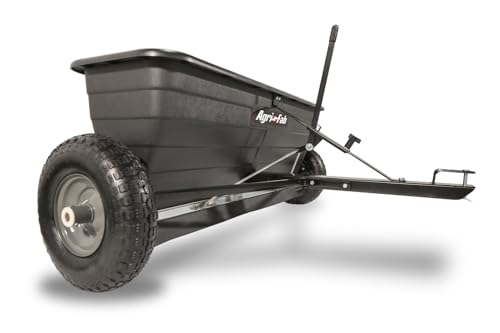
This model emphasizes wide-area coverage with a 42-inch spread width and a 175 lb dry hopper. It’s designed for versatile year-round use, including seed, fertilizer, weed control products, salt, and ice melt. Best for: larger properties or contractors who need broad coverage in a single pass. Caution: wider spread width requires careful navigation to avoid overspread on delicate landscaping or driveways.
Buying Guide: Key Purchase Considerations
What capacity do you actually need? For large lawns or frequent seasonal work, aim for 130–175 lb hoppers to minimize refills. For smaller lawns, 85–110 lb models may suffice and improve maneuverability.
How wide should the spread be? Wider spreads (up to 12–13 ft) reduce passes but require careful steering to avoid off-target application. Narrower spreads provide more control on tight lawns or landscaping beds.
Is hitch compatibility important? Universal or tractor-compatible hitches ease attachment to most riding mowers and tractors. Check your equipment’s hitch type before buying.
What about flow control? Adjustable flow or multiple discharge ports improve coverage consistency and reduce material waste. Look for models offering on-seat control for efficiency.
Durability and terrain handling matter. Models with powder-coated steel frames, rust-resistant hoppers, and larger pneumatic tires perform better on uneven ground, gravel, or snowy conditions.
Warranty and maintenance considerations. While prices aren’t listed here, consider how easy it is to source replacement parts, hoses, and covers in your region, along with available assembly guidance.
Frequently Asked Questions
- What is a pull-behind spreader best used for?
They are designed to apply granular materials like fertilizer, grass seed, ice melt, and weed control products across lawns or larger areas while being pulled by a tractor or riding mower.
- How do I choose the right spread width?
Choose a width that balances your lawn size with the need to minimize passes. Wider widths save time on large lawns but require careful steering to avoid overspreading near edges.
- What maintenance is needed for a pull-behind spreader?
Regularly inspect the hopper and spread plate, lubricate moving parts, clean after use, and replace worn seals or bearings as needed to maintain even distribution.
- Can I use a pull-behind spreader on hills or uneven terrain?
Yes, but ensure tires are suitable and the flow control is set to prevent material from spilling on inclines. Heavy models work best on stable, graded areas.
- Do these spreaders work with a variety of materials?
Most are designed for fertilizer, seed, ice melt, and similar granular materials. Always verify material compatibility with the specific model’s hopper and spread plate.