Answering the question for gardeners seeking an effective, organic approach to controlling whiteflies and related pests. This guide helps identify the best organic white fly killers for indoor and outdoor use, highlighting who each product is best for, how they work, and practical buying tips. The top picks below emphasize safety for edible crops, lower environmental impact, and straightforward application for both beginners and seasoned gardeners.
Overview: Quick buying table for the five selected products
- Bonide Captain Jack’s Insecticidal Super Soap — Best overall for broad pest control in outdoor spaces
- Safer 5118-6 Insect Killing Soap Concentrate — Best for delicate plants and ongoing maintenance
- Earth’s Ally 3-in-1 Insecticide, Miticide, Fungicide — Best for multi-disease and pest suppression
- ARBER Organic Insecticide Liquid Concentrate — Best for targeted, rapid knockdown with organic ingredients
- Garden Safe Insecticidal Soap — Best for straightforward, ready-to-use outdoor and garden applications
Bonide Captain Jack’s Insecticidal Super Soap

Bonide Captain Jack’s Insecticidal Super Soap is a versatile, ready-to-use spray designed for outdoor residential use. It tackles a broad range of pests, including adelgid, aphids, whiteflies, thrips, and spider mites, making it a practical choice for vegetable patches, ornamentals, and lawns. Its dual-action effect includes contact kill and ingestion-based control, which helps manage pests feeding on leaf surfaces as well as those exposed to leaf tissue.
Best for: Outdoor gardens and mixed landscapes where a simple, ready-to-use soap helps manage multiple soft-bodied pests without complex mixing. Useful for home gardens, fruiting trees, herbs, and ornamentals.
Why selected: The product is easy to apply, supports organic gardening practices, and covers a wide pest spectrum, providing a reliable option when whiteflies and related insects appear in outdoor settings.
Caution: Spray only when insects are active; avoid applying under intense sun or heat to reduce leaf burn risk on sensitive plants.
Safer 5118-6 Insect Killing Soap Concentrate
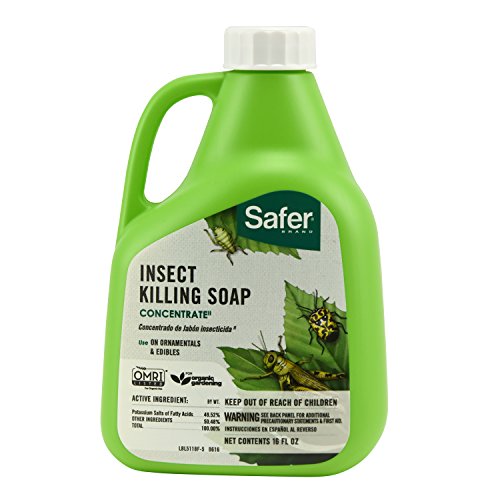
Safer 5118-6 is a concentrated insecticidal soap that provides a gentle option for a wide range of plants. It is OMRI-listed for organic use and targets aphids, whiteflies, thrips, and spider mites, among others. This concentrate is ideal for periodic treatments during the growing season and is suitable for flowers, herbs, vegetables, and houseplants.
Best for: Plant collections with a mix of ornamentals and edibles where a mild, repeatable spray is preferred to protect delicate foliage.
Why selected: Its OMRI listing and gentle formulation make it a practical choice for gardeners prioritizing organic compliance and gradual pest suppression without harsh residues.
Caution: Reapply as pests reappear and ensure coverage on the undersides of leaves for best control. Avoid applying during flowering of nectar-yielding plants if avoiding pollinator exposure is a concern.
Earth’s Ally 3-in-1 Insecticide, Miticide, Fungicide

Earth’s Ally 3-in-1 Plant Spray combines insecticide, miticide, and fungicide into a single, ready-to-use solution. The blend uses essential oils to target soft-bodied insects and also helps suppress common plant diseases. It provides residual repellency while killing pests like spider mites, aphids, and whiteflies, and also helps manage diseases such as powdery mildew and blight.
Best for: Gardens and containers where a dual-action defense against pests and fungal issues is desirable, especially in organic or low-chemical programs.
Why selected: The 3-in-1 approach saves application steps for gardeners facing both insect pressure and fungal diseases, offering a broader protective scope than a single-purpose product.
Caution: Some essential-oil blends can cause leaf sensitivity on certain plant species; test on a small area if applying to new varieties.
ARBER Organic Insecticide Liquid Concentrate

ARBER’s Organic Insecticide Liquid Concentrate provides a fast-acting approach to control fungus gnats, aphids, whiteflies, mealybugs, and spider mites. This product uses plant-safe, organic-based ingredients designed for both indoor and outdoor use, and is formulated to disrupt pest life cycles without introducing harsh synthetic residues. It’s adaptable via dilution for seedlings and mature plants alike.
Best for: Gardeners seeking a concentrated, odor-conscious option that can be tailored for different plant stages and sizes.
Why selected: The concentrate format enables precise dilution, which helps manage pest pressure while keeping residue levels low on edible crops.
Caution: As with most concentrates, follow dilution guidelines carefully to avoid under- or over-application on sensitive species.
Garden Safe Insecticidal Soap

Garden Safe Insecticidal Soap is a ready-to-use option designed for organic gardening. It provides direct contact control by thoroughly spraying on all plant surfaces, including the undersides of leaves. It is suitable for indoor, outdoor, and greenhouse use on vegetables, fruit trees, ornamentals, and more, with the flexibility to use up to the day of harvest for edible crops.
Best for: Quick, no-muss control of soft-bodied insects on mixed plantings and edible crops where ease of use matters most.
Why selected: The ready-to-use format makes it ideal for busy or first-time gardeners who want dependable protection without mixing steps.
Caution: Pests must be sprayed directly for effective control; coverage is key to achieving consistent results.
Buying Guide: Key Considerations For Organic White Fly Control
What type of pest do you primarily face?
Whiteflies often accompany aphids, spider mites, and mealybugs. Consider products labeled for soft-bodied insects and those offering some disease suppression to tackle multiple threats in one spray.
Indoor vs. outdoor use
Indoor plants typically tolerate milder formulations, while outdoor gardens may benefit from ready-to-use sprays with broader pest coverage. For larger outdoor spaces, consider concentrates that can be mixed with water for extended coverage.
Organic certification and residue
Look for OMRI-listed products if organics are a priority. Consider products with low residue on edible crops and shorter re-entry times after spraying.
Application method and coverage
Thorough coverage, including leaf undersides, is essential for effective control. Ready-to-use sprays are convenient, while concentrates offer customization for larger gardens or more targeted applications.
Plant sensitivity and test area
Some essential-oil blends or soaps can cause leaf burn on sensitive species. Test on a small area or a few leaves before wider application, especially on new or delicate plants.
Frequency and resistance management
Start with a test spray and re-apply according to pest pressure. Rotate products when possible to reduce the risk of pest resistance and to maintain effectiveness over the growing season.
FAQ: Organic White Fly Control Answers
- What is an organic white fly killer? An organic white fly killer uses plant-based oils, soaps, or essential oil blends to kill or repel whiteflies and related pests without synthetic chemicals.
- Are these products safe for vegetables and herbs? Many are labeled for use on edibles and allow spraying up to the day of harvest; always follow label directions for specific crops.
- Can I use these products indoors? Yes, several products on the list are suitable for indoor use on houseplants and in controlled environments like greenhouses.
- Should I rotate products? Rotation helps prevent pest resistance. Combine products with different active ingredients and modes of action when possible.
- How often should I spray? Reapplication intervals vary; monitor pest activity and reapply every 5–7 days as needed for prolonged infestations, or as directed on the label.
- Do these products harm beneficial insects? Most are designed to minimize impact on beneficial insects when applied directly to pests, but avoid broad spraying during bloom or in hives if pollinators are present.