Find the right drip feed irrigation kit to simplify watering, conserve water, and keep plants healthy. This guide highlights five kits that cover small to medium gardens, raised beds, and container setups. Each option is explained with who it’s best for, its key strengths, and a practical caveat to help you decide.
Summary At A Glance
| Product | Best For | Notes |
|---|---|---|
| BlueBarrel Gravity-Fed Drip Kit | Rain barrel setups, zero-pressure or low-pressure systems | Non-compensating emitters; simple gravity-fed design |
| VIVOSUN Professional Automatic Drip Kit | Precise, automated irrigation for indoor/outdoor gardens | Includes pump and timer; higher setup, more components |
| Starrey Drip Irrigation System | DIY garden, lawn, greenhouse with many adjustable nozzles | 100 ft tubing; flexible copper nozzles |
| Drip Depot Deluxe Gravity Feed Kit | Small areas with under 10 PSI; simple setup | Good low-pressure option; straightforward |
| Abakuku 230 ft Quick-Connect Kit | Large gardens and raised beds; modular expansion | Long tubing run; quick-connect fittings simplify setup |
BlueBarrel Gravity-Fed Drip Irrigation Kit

The BlueBarrel kit is designed for rain barrels, cisterns, or other zero- to low-pressure water sources. It uses a non-compensating emitter system that works without mains pressure, making it ideal for gravity-fed setups. The 45-piece kit can irrigate up to 250 square feet across 10 rows, supporting careful, even distribution. Best for buyers who rely on rainwater harvesting or want a simple, low-maintenance system.
Best for: Homeowners with rain barrels or tanks seeking a gravity-driven solution with minimal equipment. Choose this if you want a straightforward, low-pressure operation without a pump or complex tubing network.
Limitation: Performance depends on vertical height and source water level; very low sources may require adjustments to emitters for consistent flow.
VIVOSUN Professional Automatic Drip Irrigation Kit

This all-in-one professional kit includes a pump, timer, regulator, and eight emitters for precise and automated watering. It supports automated cycle watering with up to 20 irrigation times and allows manual and automatic mode switching. With a 15W submersible pump delivering up to 1000 L/H and a low noise profile, this kit aims at consistent garden watering with minimal hands-on effort.
Best for: Gardeners who want a programmable schedule and reliable automation, suitable for indoor grow rooms or outdoor plantings that require regular, uniform moisture.
Limitation: More components mean a bigger initial setup and more maintenance points than simpler gravity-fed kits.
Starrey Drip Irrigation System

The Starrey kit offers a 100-foot main line with 24 adjustable 360° copper nozzles, enabling broad coverage for gardens, lawns, and greenhouses. It’s designed for quick assembly and turnkey operation with full-connect fittings. The copper nozzles can be directed to individual plant bases, making it a strong option for varied plant layouts.
Best for: Do-it-yourself gardeners who want flexible nozzle positioning and quick setup to cover multiple beds or a mixed plant area.
Limitation: Copper nozzles may require occasional cleaning to prevent clogging in hard water zones.
Drip Depot Deluxe Gravity Feed Kit
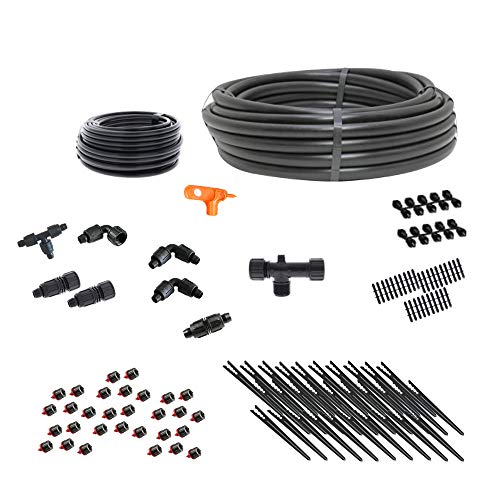
The Deluxe Gravity Feed Kit is designed for small areas that run under 10 PSI, emphasizing ease of setup and low maintenance. It’s a practical option for those who rely on gravity-fed water sources, offering a streamlined approach to consistent irrigation without the need for a powered pump.
Best for: Gardeners with low-pressure water sources who want a simple, low-cost, low-effort irrigation solution.
Limitation: Limited pressure tolerance means performance can drop if supply pressure varies widely or if tubing runs become lengthy.
Abakuku 230 Ft Quick-Connect Kit

The Abakuku kit offers a long 230-foot run with quick-connect fittings, including 1/4″ and 1/2″ tubing and a versatile set of connectors and nozzles. It supports broad expansion for larger gardens or raised beds, allowing you to route water precisely where needed and adjust coverage with a flexible layout.
Best for: Gardeners planning extensive irrigation layouts across multiple zones or larger plots, who value modular connectivity and simple expansion.
Limitation: The longer tubing network may require careful planning to avoid uneven watering in distant zones.
Buying Guide: Key Considerations For Selecting A Drip Irrigation Kit
What water source do you plan to use? Gravity-fed systems work well with rain barrels and cisterns, while pumped systems are better for consistent pressure and broader coverage.
- Pressure needs: If your water source is under 10 PSI, choose gravity-feed or low-pressure kits. For higher pressure, consider kits with regulators and adjustable emitters.
- Coverage area: Measure your garden size and bed layout. Kits with longer tubing and many emitters are better for larger or irregular layouts.
- Automation vs. manual: If you prefer hands-off watering, prioritize kits with timers and programmable cycles. For simple setups, gravity-fed or manual kits may suffice.
- Emitter type: Non-compensating emitters are simple and compatible with low pressure; adjustable nozzles offer targeted watering but may require more maintenance.
- Expandability: Look for kits that allow adding more lines, emitters, or zones without a complete rework.
- Materials and durability: Check tubing quality and fittings for resistance to sun exposure and clipping pests. Copper nozzles, while flexible, may need occasional maintenance.
Frequently Asked Questions
- What is a drip irrigation kit best for?
A drip kit is best for delivering water directly to roots with minimal waste, suitable for small gardens, raised beds, containers, and greenhouse setups.
- Do I need a pump for drip irrigation?
Not always. Gravity-fed kits work without a pump if your water source provides enough height and pressure. Pumped kits are better when consistent pressure is required across larger areas.
- How do I choose between gravity-fed and pumped kits?
Choose gravity-fed for simple, low-maintenance setups with rainwater. Choose pumped systems for precise control, larger areas, and environments with variable elevation.
- Can I expand an existing kit later?
Yes, many kits are designed for expansion with additional emitters, tubing runs, and connectors. Check compatibility with your current layout.
- How often should I replace emitters or tubing?
Emitters and tubing typically last several seasons; inspect regularly for clogging and wear, especially in hard water or high sunlight areas.