Concrete flower bed edging molds help you create clean, professional-looking borders for gardens, walkways, and patios. This guide highlights five versatile options, explaining who each is best for, and why they stand out. Perfect for DIYers, homeowners on a budget, and landscape enthusiasts seeking durable, reusable edging solutions.
The table below compares top picks to help you choose quickly. If you’re planning curved borders, circle edging, or straight lines, these options cover common landscaping needs.
| Product | |
|---|---|
| SvitMolds Set of 4 Plastic Concrete Curb Molds | Two straight borders and two decorative radii; versatile for mixed layouts |
| Greek Roman Floral Border Edging Mold 5005 | Intricate border designs for decorative garden borders |
| SvitMolds 2-Piece Round Edge BR04 | Large circular borders and curved layouts |
| BETONEX 2-Piece Straight Edge Molds | Classic straight edge stones and repeatable tiles |
| U0U 4×78.7 Inch Plastic Concrete Forms | Walkways and flexible path edging with modular sizing |
SvitMolds Set of 4 Plastic Concrete Curb Molds

The set includes two straight borders and two decorative radius borders, enabling both linear and curved sections in one project. Material is durable ABS plastic, designed for repeated use with minimal deformation. Outer diameters scale up to wide circular layouts, making it suitable for larger circular borders.
Best for: DIYers who want mixed border options in a single purchase and need durable, reusable molds. This kit saves time by combining straight and curved pieces. Caution: larger circle compatibility depends on segment counts and wall thickness; ensure your wall thickness aligns with the mold dimensions.
Greek Roman Floral Border Edging Mold 5005
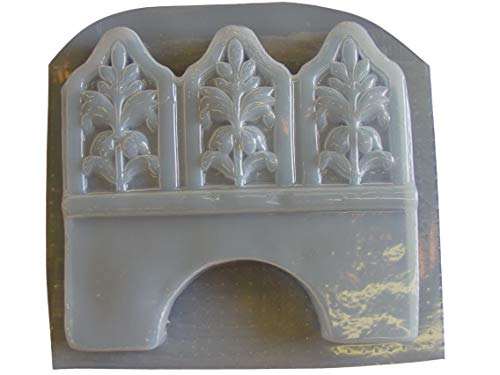
This decorative border mold delivers a Greek-Roman inspired floral motif for edging projects. Its dimensions are 12 inches by 11.5 inches and 1.5 inches thick, enabling decorative borders that stand out in beds and patios. Use with concrete or cement to craft ornate borders that elevate curb appeal.
Best for: Garden designers and homeowners seeking ornamental borders with a classic motif. It’s a good match for accent borders along flower beds or entryways. Caution: the decorative pattern is best suited for shallow embedding; deeper edging may require alignment planning.
SvitMolds Concrete Molds DIY 2-Piece BR04 Round Edge

This two-piece molding set is designed for smooth, rounded borders that quickly upgrade gardens, patios, and lawns. The outer circle diameter measures 47.2 inches, while the inner circle is 36.85 inches, producing a generous circular border or curved edging. The set is optimized for faster results due to paired molds and consistent cornering.
Best for: Projects requiring robust, uniform curved borders with a clean circular look. Choose this when you want a fast production cycle for circular garden features. Caution: eight segments are needed to complete a circle; plan your layout to avoid seams in visible positions.
BETONEX 2-Piece 23.34 Inch Straight Edge Molds

These two-piece ABS plastic molds are designed for straight-edge stone borders. They can produce more than 50 tiles for a repeating garden border, making them a cost-effective choice for long straight sections. The simple DIY approach makes them accessible for beginners while still delivering a professional finish.
Best for: Homeowners building long straight borders or edging that requires repeatable tile patterns. Caution: the set is optimized for straight lines; curved sections require additional molding solutions or different molds.
U0U 4×78.7 Inch Plastic Concrete Forms

This set provides modular, long edge forms suitable for walkways and garden paths. Each form measures about 4 x 78.7 x 0.24 inches, and the polyethylene construction supports repeated use with simple removal and cleaning. Built to resist cracking and bending under typical molding pressure.
Best for: Builders creating repetitive path borders or long, cohesive edging sections. Choose this if you need scalable lengths and easy assembly. Caution: assembly requires careful alignment to avoid gaps at joints.
Buying Guide: Key Considerations For Concrete Flower Bed Edging Molds
What edging shape matches my landscape?
Decide between straight borders, curved borders, or ornamental shapes. Straight molds are ideal for clean lines along flower beds, while curved or circular molds work well for round garden borders and patios.
What material and durability matter?
Most molds use ABS or polyethylene plastics. Look for thick walls, a durable finish, and clear wall thickness specifications to ensure repeated use without warping.
How many segments do I need for curves?
Curved borders often require multiple segments to form a complete circle. Plan your layout by counting segments and considering seam placement for a clean look.
Is easy removal important?
Non-stick or smooth-surfaced molds ease demolding. Flexible or high-quality plastics reduce sticking and damage when removing cured concrete.
Do I need decorative patterns or simple edges?
Decorative molds add aesthetic value but may require more precise alignment or finishing. If you want quick borders, choose simpler patterns with repeatable shapes.
FAQ
- What type of concrete works best with these molds? Standard concrete mixes suitable for edging molds include bagged concrete or a DIY mix with appropriate water-to-paste ratio for workable consistency.
- How many molds should I buy for a typical bed border? It depends on the length of edging; longer borders benefit from sets that include multiple straight and curved pieces for faster completion.
- Can I reuse molds after removing the cured border? Yes. Proper cleaning and drying help maintain mold integrity for repeated use.
- Are these suitable for outdoor weather? Most molds are designed for outdoor use and should resist cracking under typical garden conditions when used with proper curing.
- Will these create uniform borders along winding paths? Modular and curved molds help create consistent borders, but precise layout planning minimizes seams and ensures a uniform look.
- Do any molds require special tools? A rubber mallet may be helpful for seating edging, and stakes or guides can aid alignment for straight sections.