Choosing the right air conditioner for a concession trailer or RV helps keep guests comfortable and equipment functioning smoothly. The following five models offer a mix of rooftop non-ducted units and portable/retrofit options with varying BTU capacities, energy efficiency, and compatibility. Use this guide to compare cooling power, heating options, installation ease, and compatibility with common RV systems.
| Product | Brand | BTU / Type | Key Benefit | Link |
|---|---|---|---|---|
| ACiQ 15,000 BTU RV Air Conditioner with Heat Pump | ACiQ Store | 15,000 BTU cooling / 12,000 BTU heating | High cooling capacity for larger spaces; eco-friendly refrigerant | Amazon |
| VEVOR RV Air Conditioner 13,500 BTU | VEVOR Store | 13,500 BTU | Compatibility with multiple controllers; ductless | Amazon |
| RV Air Conditioner 12V 10,000 BTU | outequip Store | 10,000 BTU / 4,500 BTU heater | Low-profile, battery-powered option | Amazon |
| Midea Duo 12,000 BTU (10,000 SACC) | Midea Store | 12,000 BTU inverter | Ultra-quiet, energy efficient with hose-in-hose design | Amazon |
| Dometic FreshJet FJX3000 Series | Dometic Store | Non-ducted rooftop unit | Powerful airflow; easy assembly | Amazon |
The table highlights a mix of rooftop non-ducted and portable solutions, so you can weigh capacity, heat options, and installation complexity for your concession trailer. Each option is selected to work with common RV setups and shore power environments.
ACiQ 15,000 BTU RV Air Conditioner With Heat Pump

The ACiQ 15,000 BTU rooftop unit provides robust cooling for larger concession spaces, with 12000 BTU of heating for cool-to-warm nights. Designed for RVs and motorhomes, it operates on 115V and supports eco-friendly R32 refrigerant. The rotary compressor enhances efficiency, keeping amp draw manageable for shore power, generators, or inverters. This non-ducted system is suitable for campers up to roughly 600 sq. ft. and is marketed as a reliable HVAC solution from certified ACiQ sellers.
VEVOR RV Air Conditioner 13,500 BTU

This ductless rooftop option delivers rapid cooling for RV spaces up to about 107.6 sq. ft. It uses a 13,500 BTU compressor and R32 refrigerant, and claims quick cooling within about 10 minutes of activation. The model is designed to be compatible with popular ceiling assemblies and controllers like Dometic Brisk Air and Brisk II, simplifying retrofits. Installation is straightforward for compatible RV models with standard rooftop vents, and it is ideal for upgrading older systems in non-ducted configurations.
RV Air Conditioner 12V 10,000 BTU Rooftop
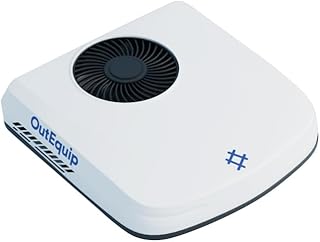
This 12V rooftop unit delivers 10,000 BTU cooling, plus a 4,500 BTU heater for mild weather. Designed for RVs, trucks, vans, and trailers, it emphasizes low-profile construction and durability. The unit is described as weather-resistant, using UV-stabilized ABS materials and a zinc-coated condenser to withstand challenging outdoor conditions. While not a primary heat source in extreme cold, the built-in heater provides useful auxiliary warmth for shoulder seasons.
Midea Duo 12,000 BTU Inverter Portable AC

The Midea Duo combines inverter efficiency with a hose-in-hose design that enhances whole-room cooling by improving air circulation and limiting hot air leakage. This 12,000 BTU (10,000 SACC) unit runs on a variable-speed inverter to reduce electricity use by a notable margin compared to traditional portable ACs. Features include remote control, smart compatibility (Alexa/Google), and a built-in cooling capacity that targets up to 450 sq. ft. This model emphasizes energy savings and quiet operation, making it suitable for semi-permanent concession setups indoors when portability is a consideration.
Dometic FreshJet FJX3000 Series Rooftop AC

The FreshJet FJX3000 Series is a non-ducted rooftop option with powerful airflow and intuitive operation. Its two-piece design simplifies assembly and installation for concession trailers and smaller RVs. It’s positioned as a straightforward, reliable choice for spaces that require strong airflow without ductwork, aligning with typical RV roof configurations. This unit is suitable for owners seeking a robust mechanical option with straightforward maintenance and operation.
Buying Guide: Key Purchase Considerations
- Rooftop vs. portable: Rooftop units save interior space and can be installed permanently, while portable or battery-assisted models offer flexibility for non-permanent setups or temporary events.
- BTU capacity vs. space: Larger trailers or concession spaces require higher BTU. Match capacity to square footage for efficient cooling/heating and avoid overworking the system.
- Heat options: If you operate in variable climates, consider units with heat pump capability or built-in heating to cover shoulder seasons and nights.
- Power requirements: Check shore power compatibility and potential inverter or generator needs. Inverter models can modestly reduce energy usage for extended events.
- Energy efficiency: Look for refrigerants with lower global warming potential (like R32) and inverter technology to lower electricity use over time.
- Compatibility and installation: Confirm compatibility with your trailer roof dimensions, vent openings, and existing controllers. Some units are designed to fit standard 14.25 x 14.25 inch rooftop openings.
- Maintenance and access: Consider units with accessible service panels and straightforward drain, filter, and condenser maintenance to minimize downtime between events.
- Noise level: For concession environments, quieter models improve guest experience. Check decibel ratings and user reports when possible.
- Durability and climate resistance: Exterior and gasket materials determine performance under sun, rain, and temperature swings common in outdoor events.
- Warranty and support: A strong warranty and accessible customer support can protect your investment in seasonal operations.
When selecting an air conditioner for a concession trailer, it is essential to weigh cooling/heating needs, installation practicality, and energy use. The above models provide a spectrum of choices—from high-capacity rooftop units to compact, inverter-driven portable options—allowing you to balance performance, cost, and long-term reliability for your business environment.