Looking for clear plastic hose tubes that are easy to see flow, flexible, and durable? This guide highlights five top picks well-suited for general hobby, home repair, watering, and light industrial needs. Each product is chosen for ease of use, compatibility with common fittings, and clear interior visibility. Best for DIYers, hobbyists, and small-scale setups who want reliable, transparent tubing with straightforward cutting and installation.
| Product | Length / Size | Key Benefit |
|---|---|---|
| Eastrans 10 ft x 1/4″ ID | 10 ft, ID 1/4″ | Lightweight, flexible, chemical resistant |
| Eastrans 1/2″ ID, 5 ft | 5 ft, ID 1/2″ | Balanced diameter for higher flow |
| Eastrans 5 ft x 3/4″ ID | 5 ft, ID 3/4″ | Wide bore for bigger transfers |
| DERNORD 1/4″ ID x 3/8″ OD, 10 ft | 10 ft, ID 1/4″ | Food grade option with clear interior |
| Kesoto 10 ft ID 1/4″ | 10 ft, ID 1/4″ | Versatile water and air use |
Eastrans 10ft Clear Vinyl Tubing — 1/4″ ID

Best for compact projects where a precise, small-diameter flow path is required. This PVC tubing is lightweight, flexible, and resistant to abrasion and most mild chemicals. The smooth interior reduces sediment buildup and eases flushing. Diameter is 1/4″ ID, 3/8″ OD, with a 10-foot length and 1.55 mm wall thickness. Temperature tolerance from -5°C to 65°C and a working pressure around 60 PSI. Choose this if you need a long, narrow tube for devices like small reservoirs, air lines, or hobbyist circuits. Avoid if you require a larger bore or food-grade certification beyond general use.
Best for: small-diameter transfer tasks, DIY projects, lightweight lines for air or water at modest pressures.
Eastrans Clear Vinyl Tubing — 1/2″ ID, 5 ft
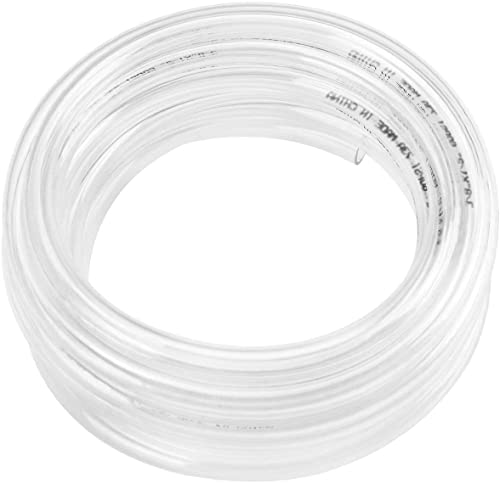
Best for medium-flow applications where a larger internal diameter improves throughput without sacrificing visibility. The tubing uses a high-quality PVC formulation that remains flexible, with smooth interior and exterior for easy flow and cleaning. ID is 1/2″, OD 5/8″, 5 feet long, wall thickness 1.6 mm, and rated around 60 PSI. Temperature range is -5°C to 65°C. Use this when you need stronger flow than 1/4″ but still want a clear view of the liquid. Limitations include lower flexibility at extreme bends compared to smaller diameters.
Best for: larger liquids or higher-volume tasks in home gardens, aquariums, or small mechanical systems.
Eastrans 5 ft x 3/4″ ID Clear Vinyl Tubing
Best for higher-capacity transfers in small systems where a 3/4″ ID helps move larger volumes quickly. The PVC tubing features a 3.15 mm wall thickness and 73A hardness, ensuring rigidity while remaining workable for cutting and shaping. Temperature tolerance is -5°C to 65°C with a 30 PSI working pressure. This tubing is suitable for water, mild chemicals, and general light industrial uses. Consider this when you need minimal flexibility but robust flow capacity. Might be less ideal for very tight bends.
DERNORD PVC Tubing 1/4″ ID x 3/8″ OD — 10 Feet

Best for food-grade or general industrial uses where a transparent pathway is required. This DERNORD tubing measures 1/4″ ID and 3/8″ OD, with a 10-foot length. The interior and exterior are designed to minimize sediment buildup and ease cleaning, making it a practical choice for liquids and semi-solids. Heat tolerance matches common household and workshop environments. Use this if you need a durable, easy-to-clean line that can connect to standard barbed fittings. It may be overkill for very small, precision tasks.
Kesoto 10 Feet Clear Vinyl Tubing — 1/4″ ID

Best for flexible, general-purpose water or air transfer in hobby projects or basic setups. It is translucent PVC tubing, 1/4″ ID. Use this for light-duty use in aquariums, small hydroponics, or DIY experiments where you need to observe flow. The product description notes suitability for both water and air transfer. A potential limitation is lower chemical resistance compared to high-grade industrial tubing, so avoid aggressive solvents.
Buying Guide: Key Considerations
- Diameter matters: 1/4″ vs 1/2″ vs 3/4″ IDs affect flow rate and pressure handling. Choose based on your needed throughput and available fittings.
- Material and safety: PVC clear tubing is common for general use. For food or beverage handling, confirm food-grade labeling or certifications from the seller.
- Temperature and chemical compatibility: Check the operating range (usually around -5°C to 65°C) and resistance to alkalis, solvents, and mild acids.
- Flexibility vs. rigidity: Smaller IDs are typically more flexible; larger IDs offer higher flow but can be stiffer and harder to route around tight corners.
- Length and cut-ability: Longer runs require easier cutting and edge finishing to prevent leaks at connections. Ensure compatibility with standard hose barb fittings.
- Intended use: Water vs air vs semi-solids; consider whether translucence for flow monitoring is a priority and whether food-grade tubing is required.
FAQ
- What does ID and OD mean in tubing specs?
ID is the inner diameter, OD is the outer diameter. The wall thickness is determined by OD minus ID, divided by two. This affects fit with fittings and flow capacity.
- Is clear tubing suitable for food applications?
Some clear PVC tubing is marketed as food-grade. If that is essential, verify the product specifications or certifications with the seller before use.
- Can these tubes handle high-pressure systems?
Most consumer clear vinyl tubing is rated for modest pressures (often around 30–60 PSI). For high-pressure systems, select tubing with an appropriate rating or use reinforced options.
- How should I cut and seal clear PVC tubing?
Use a sharp tubing cutter or utility knife, deburr edges, and apply suitable hose clamps or barbed fittings with appropriate sealants or connectors.
- Are there alternatives to PVC tubing for chemical resistance?
Yes. For stronger chemical resistance, consider fluoropolymer or silicone options, though they may be more expensive and less flexible.