Answering your search for a compact, efficient 36W grow light, these picks deliver full-spectrum lighting ideal for seed starting, leafy greens, and small indoor setups. Each option is chosen for strong PPFD at close distances, reliable heat management, and practical features like timers or linkable panels. Best for compact grow racks, desktops, or beginner setups. The top five products below are selections that balance performance, energy efficiency, and value for typical home indoor gardens.
| Product | Brand | Key Strength | Best For | Link |
|---|---|---|---|---|
| SANSI Grow Lights for Indoor Plants, 36W | SANSI | Full spectrum with high PPFD, long bulb life | Seed starting and compact shelves | View |
| Barrina TX36 2FT LED Grow Light, 36W | Barrina | 2 panels, high PPFD, easy daisy-chain | Small indoor gardens and modular setups | View |
| Bstrip T8 Grow Light, 36W (2 x 18W) | Bstrip | Full spectrum with red LEDs, timer | Budget-friendly, travel-friendly setups | View |
| FECiDA Gamechanger 36W, 4 Head with Timer | FECiDA | Multi-head design, 5-mode timers | Tall plants or larger starter trays | View |
| FECiDA Gamechanger 2026 36W, 4 Head | FECiDA | No adapter needed, replaceable bulbs | Flexible placement and long-term use | View |
SANSI 36W Full Spectrum Indoor Grow Light

The SANSI 36W grow light uses a 4000K daylight spectrum that mimics natural sunlight. It covers the full 400nm-780nm range for a complete life-cycle light program. The secondary optical design provides a PPFD around 265.58 μmol/s/m² at 1 ft, supporting steady plant growth. A ceramic heat sink and patented CO C technology help manage heat for longer bulb life. Best for compact shelves, seed starting, and leafy greens where consistent daily light is needed. Caution: replacement bulbs may be required over time to maintain intensity.
Barrina TX36 2FT LED Grow Light

Barrina TX36 delivers 36W and replaces a 200W equivalent with 156 LEDs producing a high PPFD of 526.68 μmol/m²/s at 3.94 inches. It uses a red (620-680nm) and blue (430-460nm) full spectrum to accelerate germination, flowering, and fruiting. Ideal for small herb gardens or compact seed trays. Best for users who need strong target lighting in a tight space and easy setup with daisy-chaining. Limitation: no built-in dimming or spectrum adjustment, so you rely on fixed output per unit.
Bstrip T8 36W Full Spectrum Grow Light

Bstrip offers a 2-pack 36W T8 setup with full spectrum and 660nm red LEDs. It provides about 314 μmol/m²/s PPFD at a 4-inch distance and features a timer with 4/9/14-hour auto cycles. This makes it suitable for travel or busy households needing reliable daily lighting. Best for budget-conscious growers who want consistent daily cycles without manual switching. Caution: larger or taller plants may require higher hanging height to prevent light saturation.
FECiDA Gamechanger 36W 4-Head Grow Light
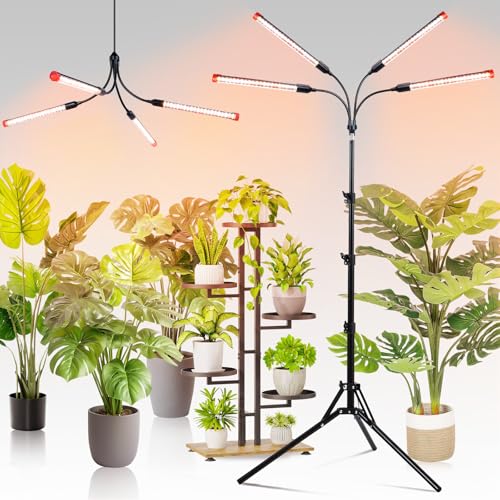
This 36W 4-head model provides broad coverage with 168 LEDs and a natural full spectrum. It includes 3000K, 5000K, and 660nm LEDs for versatile light tuning and a 5-mode timer for auto on/off. Best for tall plants, bonsai, or seed starting where wider distribution enhances growth. Limitation: does not rely on an external adapter, which can be positive for placement flexibility but may require careful cord management.
FECiDA Gamechanger 2026 36W 4-Head Grow Light

Another 36W option from FECiDA, designed with replaceable bulbs and a natural sunlight full spectrum. The 4-head configuration supports flexible placement for seedling trays or compact shelves. Best for long-term use and scenarios where bulb replacement is desired to extend overall life. Caution: may require more setup space compared to single-head designs.
Buying Guide: Key Considerations for 36W Grow Lights
- Light spectrum and intensity: Look for full-spectrum coverage (roughly 400-780 nm) with adequate PPFD at the distance you plan to mount the light. Higher PPFD at close range supports faster seedling growth but may require height adjustments as plants mature.
- Fixture design and footprint: Compact 2-foot or T8 configurations fit on shelves, desks, or small benches. Multi-head or daisy-chain options offer broader coverage for multiple plants.
- Heat management and longevity: Consider heat sinks, ceramic substrates, or replaceable bulbs. Efficient heat management contributes to bulb life and stable light output.
- Timers and automation: Built-in timers help maintain consistent day/night cycles, important for consistent growth and stress-free operation.
- Placement and spread: Decide between single-panel, multi-panel, or round configurations based on plant type and spacing. Wider spread helps uniform growth on larger trays.
- Power and energy use: A 36W fixture is energy-efficient, but total energy cost depends on daily run hours. Compare effective PPFD per watt for true efficiency.
- Replacement and maintenance: Some models offer replaceable bulbs or easy-swap components. Factor long-term upkeep into the total cost of ownership.
Frequently Asked Questions
- What does PPFD measure and why does it matter?
PPFD indicates the photon flux reaching plant tissue per second per square meter, reflecting light intensity that drives photosynthesis. Higher PPFD at the plant canopy generally supports faster growth, up to the plant’s tolerance. - Is a 36W grow light enough for tomatoes or large plants?
For small trays or compact setups, 36W can support seedlings and leafy greens. Taller or fruiting plants may require higher-powered fixtures or additional fixtures for even coverage. - Should I choose a fixed spectrum or adjustable spectrum?
Fixed-spectrum models are simple and reliable for straightforward stages (seedling to vegetative). Adjustable spectrum offers customization for different growth stages but adds complexity and cost. - Are all 36W lights interchangeable with adapters?
Most 36W implementations are designed for direct operation or with their own built-in power options. Check whether a separate adapter is needed and ensure compatibility with your power setup. - How many hours per day should I run a 36W light?
Common guidance is 12–18 hours per day for vegetative growth, with a consistent day/night cycle. Use timers to maintain regular schedules, especially during busy weeks.